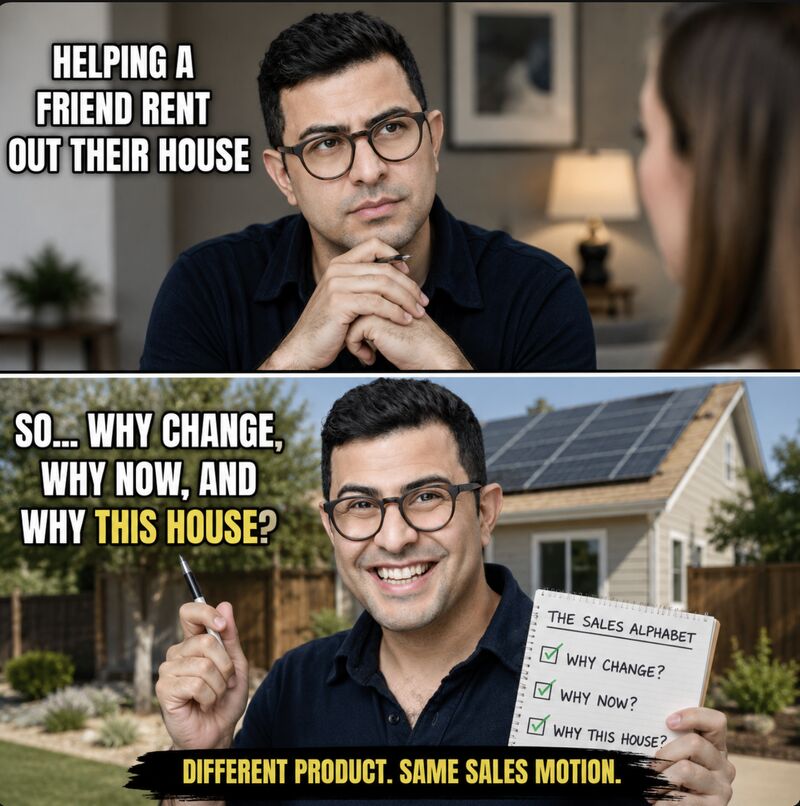
Apparently, renting out a house is a lot like SaaS sales. Both are based on ARR and relationships.
Do not worry; I am still in tech sales.
I was helping a friend rent out a house when a family came to see it. As I walked them through the rooms and the backyard, I caught myself doing discovery. Not because I planned a sales process for a rental showing, but because the questions were the same ones I use to understand a technical deal.
Why change? Why now? Why this?
Different product. Same sales motion.
Why change?
This is the pain. What is happening in the buyer's current situation that makes staying put uncomfortable?
The family wanted to be closer to their children's school. They needed to downsize. They wanted a backyard without a pool. And they told me they were paying more than $1,000 for electricity.
Those details mattered more than a generic list of preferences. "We want a nice house" tells you almost nothing. Wanting a shorter school commute, lower energy costs, and a safer outdoor space tells you exactly what the current situation is costing them.
In a software deal, the same principle applies. A prospect does not buy because your platform has an impressive feature list. They buy because the current way of working is slow, expensive, risky, or limiting something the business needs.
If you cannot explain the pain of staying the same, you do not yet understand the opportunity.
Why now?
This is urgency. A real problem does not always produce a real project. Something has to turn discomfort into action.
For this family, the lease ended the following month. They needed less space, and waiting meant another enormous electricity bill. The timeline was not manufactured by a seller. It already existed in their life.
Good discovery does not invent urgency. It uncovers it.
In enterprise sales, the deadline might be a contract renewal, a product launch, a regulatory requirement, a capacity limit, or an executive commitment. Without a meaningful event and a consequence for missing it, "urgent" often means only that the seller wants the deal this quarter. Buyers can feel the difference.
Why this house?
This is the value. The house had a fenced backyard, enough bedrooms, a safe neighborhood, proximity to the school, and full solar power. Each detail mapped directly to something the family had already said mattered.
The feature did not create the value by itself. The connection did.
Solar panels are just a feature until a family tells you that electricity costs more than $1,000. A fenced yard is just a feature until safety and the absence of a pool become important. Distance to a school is just a number until you understand the daily commute.
The same is true in technical sales. Faster processing, stronger controls, and easier integrations are not value propositions on their own. Their value depends on the problem, the timing, and the person experiencing the outcome.
Discovery reveals the competition
Here is the fun part: "Why change?" also tells you what you are really competing against.
Once you understand what someone needs, you can evaluate the alternatives honestly. What other houses solve the school problem? Which ones reduce the electricity bill? What do they cost? What compromise does each option require?
In SaaS, the competition is not always another vendor. It might be an internal tool, a manual process, a different priority, or doing nothing. You only learn which one matters by understanding the pain precisely.
This little real estate experience reminded me that sales frameworks work because human decisions have recognizable patterns. We move when the current situation stops working, when the timing creates a reason to act, and when one option connects clearly to what we value.
You can call it discovery, qualification, or simply paying attention. The alphabet is the same.
Why change? Why now? Why this?
Answer those three honestly, and most of the sales conversation becomes much simpler.