If you’re starting as a #BDR or a #CEO with no sales experience, I want you to try an experiment that has nothing to do with Salesforce, sequences, personalization, or sending 10 emails before finally working up the courage to call someone. Go talk to strangers.
I started as a BDR at Databricks, later became an AE, and got to mentor BDRs myself. One thing has proven true over and over: consistency matters more than perfection. I know because I’m a perfectionist, which is a fantastic quality if you’re building a Swiss watch and a terrible one if your job requires making 50 calls.
You don’t need the perfect pitch. Pick up the phone, say your piece, record yourself, cringe at your own voice, recover emotionally, and listen back. You’ll start noticing your tone, pacing, where you sound scripted, and where you actually sound human. The trick is to listen from the prospect’s perspective, not your own.
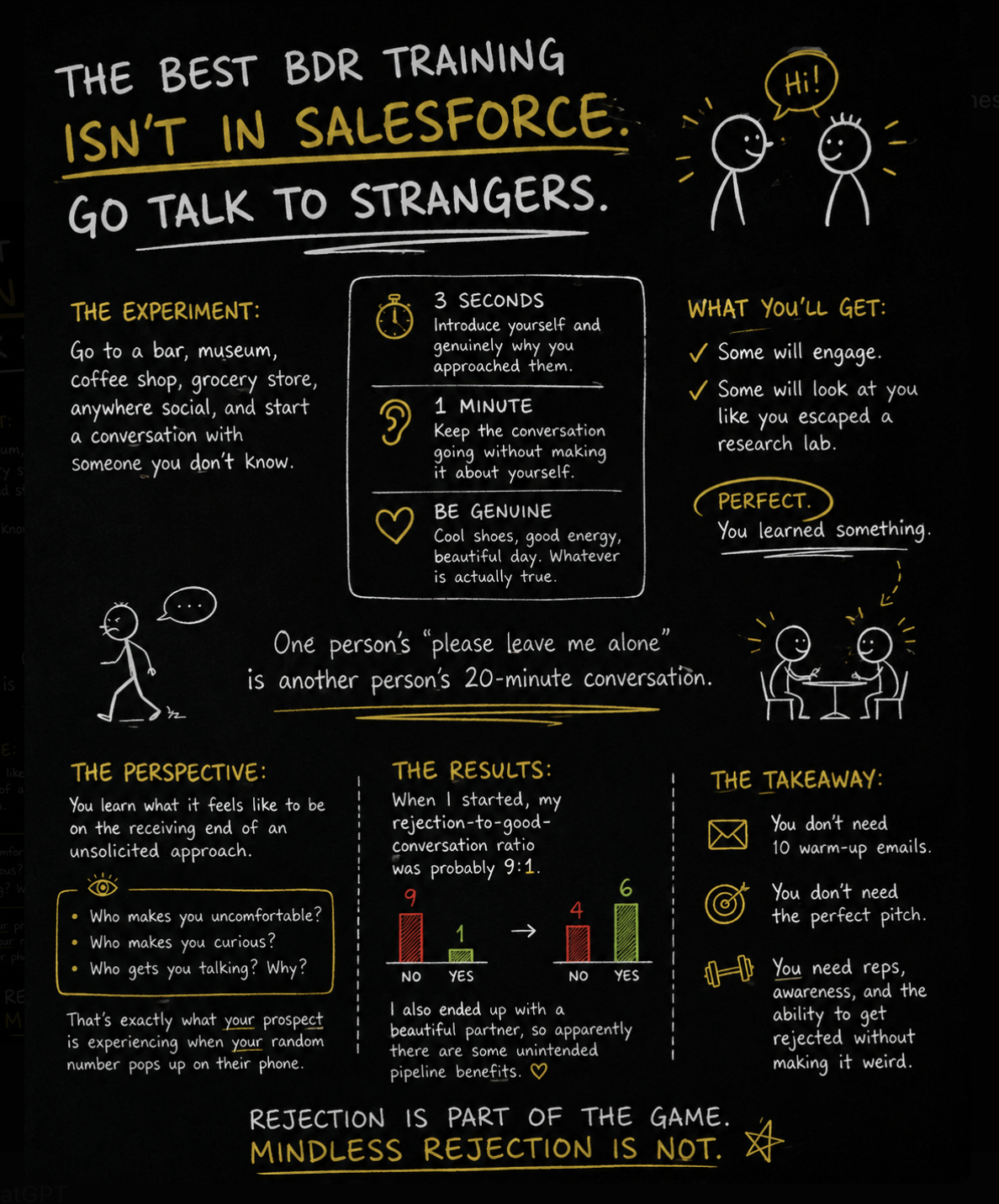
Now for my slightly unhinged experiment. Go to a bar, museum, coffee shop, grocery store, anywhere social, and start a conversation with someone you don’t know. Give yourself 3 seconds to say hi and give them a genuine reason you approached them. Cool shoes, good energy, beautiful day, whatever is actually true. Then try to keep the conversation going for a minute without making it about yourself.
Some people will engage. Some will look at you like you’re trying to sell them solar panels. Perfect. You learned something. Don’t blame yourself, and don’t blame them. Change the tone, timing, opening, energy, and try again. You’ll quickly realize that one person’s “please leave me alone” is another person’s 20-minute conversation.
More importantly, you learn what it feels like to be on the receiving end of an unsolicited approach. Who makes you uncomfortable? Who makes you curious? Who gets you talking? Why? That’s exactly what your prospect is experiencing when your random number pops up on their phone.
When I started doing this, my rejection-to-good-conversation ratio was probably 9:1. Now it’s closer to 4:6. I also ended up with a beautiful partner, so apparently the experiment had some unexpected pipeline expansion.
You don’t need 10 warm-up emails. You don’t need the perfect pitch. You need practice, awareness, and the ability to get rejected without making it weird.
Rejection is part of the game. Mindless rejection is not.