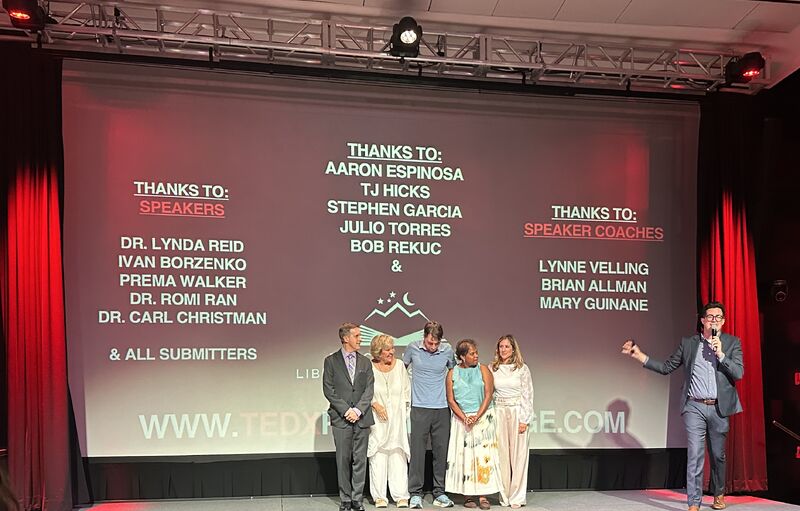
I went to TEDx Rancho Mirage expecting a few interesting talks. I left thinking about grief, Forrest Gump, compost, mind-reading, silence, and, apparently, how badly I need to exercise more.
Five speakers took the stage with completely different subjects. By the end, I realized they were all asking us to practice the same thing: attention. Attention to our pain, our stories, our assumptions, our communities, and the ordinary world in front of us.
Grief and the craft of storytelling
Dr. Lynda Reid spoke about grief. What stayed with me was not only the message that grief is something we learn to carry rather than simply "move on" from. It was how she told the story.
Every word felt intentional. Every visual had a purpose. Nothing felt wasted. I was completely connected.
As someone in sales, I kept thinking: this is the job. Every product needs a story. Features matter, but people remember the story that helps them understand why those features matter. People buy from people, and making someone feel something while keeping the message clear is a real skill.
Emotion without clarity becomes noise. Clarity without emotion becomes forgettable. Great storytelling holds both.
If you work in sales, start with Dr. Reid's talk when it becomes available. The subject is grief. The storytelling is a masterclass.
The third door
Ivan Borzenko was told as a child that he might never walk. Years later, he pursued a Guinness World Record during a 320-mile triathlon and served with an emergency medical team on Everest.
One line stayed with me:
When the doors are closed, there is always a third door.
I am in sales, so I have heard every possible version of "find another door." Hearing it from someone who built his life around that idea hits differently. Resourcefulness sounds easy in a motivational quote. It becomes real when the obvious routes are genuinely unavailable.
Ivan also successfully motivated me to start exercising more. Thank you, I think.
Waste is a design decision
Prema Walker grew up in India and eventually turned organic waste into a business and community mission in the Coachella Valley. Her work connects compost, soil, food security, and local infrastructure.
This one felt personal because I volunteered with The Urban Farmers in the Bay Area, harvesting fruit from people's backyards and getting it to people who needed it. That experience taught me how much abundance becomes invisible when the system has no path for using it.
Prema's work moves the idea upstream. Food scraps and organic waste are not merely something to remove. With a better loop, they become soil and future food. What looks like an ending in one system can be an input to another.
Knowing the trick does not remove the wonder
Dr. Carl Christman turned the room into a live experiment in "mind-reading"; kind of. Psychology, body language, experience, and observation seemed to be working behind the curtain.
It felt like watching a magic show while knowing there was science involved, which somehow made it more interesting. The performance was a reminder that close observation can look supernatural to people who are not seeing the signals.
The same is true in business. Great communicators and sellers are often described as naturally intuitive. Usually, they are paying attention to details other people miss: a change in tone, an unasked question, the person who stopped participating, or the word a buyer keeps repeating.
Silence makes room to see
Dr. Romi Ran spoke about the constant noise in our minds, silence retreats, and extended dark-room retreats. She described emerging from darkness, seeing a tree, and actually observing it before the usual flood of thoughts returned.
That image stayed with me. It reminded me of hiking into the mountains, sitting somewhere with nothing to do, and simply looking around. No notification, pitch, or productivity goal. Just being there.
Silence is uncomfortable partly because it removes the distractions that keep us from noticing what is already present. But attention needs space. Without it, we react to our own running commentary instead of the world.
The common thread
Grief, endurance, compost, mind-reading, and silence sound like five unrelated subjects. Together, they formed one lesson: pay attention.
Pay attention to what a person is carrying. To the story that makes information matter. To the door no one else noticed. To the value hidden in what we discard. To the signals behind the trick. To the tree in front of us before our thoughts name it and move on.
Attention is not passive. It changes what we understand, what we build, and how we treat people.
I arrived expecting ideas. I left with a practice.